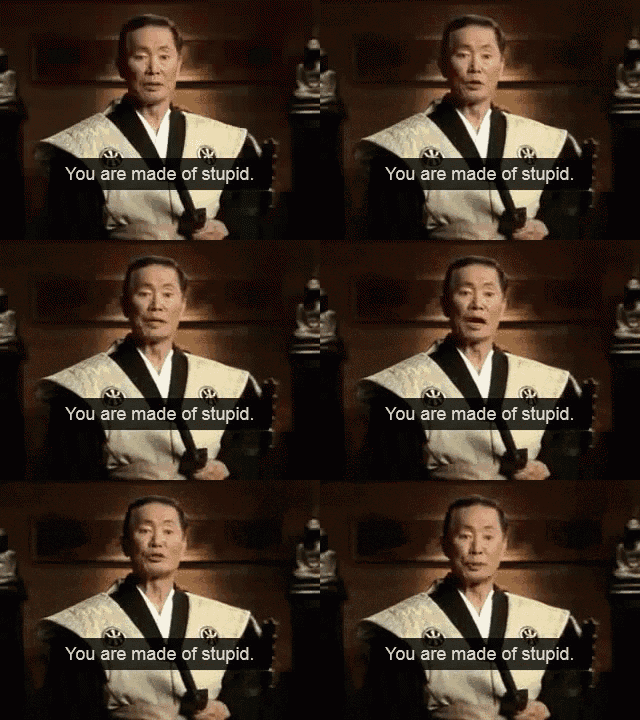
moronomaniacal decay
the half life of our intelligence is shorter than we think


7 + 2 = __ + 6
If reports are to be believed, a quarter of new STEM freshmen in remedial math courses at the University of California San Diego (UCSD), which consistently ranks in the top five to ten public universities in the nation, were unable to solve this problem.
This feels like a hoax. And in the current era, that’s really saying something — because our collective Overton window is so far out of whack already.
The authors, despite their nerdiness, have never exhibited any delusions of intellectual grandeur. There’s plenty of smart people everywhere, even if they’re not read-Wikipedia-for-fun types. We include this unusual fourth-wall note to assure you that we are not inclined to catastrophize falling test scores compared to China or rising social media addiction — like most other problems, a data snapshot of this sort does not indicate the end of Western supremacy or anything like that. What the current data and anecdotes do show is a decline in academic and intellectual capability unlike anything we’ve seen before in the era of widespread public education, identified nearly universally by educators from middle school teachers to upper-level university course instructors.
Something bad is actually happening this time, and it’s not just vibes.
People demand freedom of speech as a compensation for the freedom of thought which they seldom use.
― Søren Kierkegaard, supposedly
How is it that we’re allowed to talk without thinking for even a moment‽
— authors, definitely
If you have talked to any teachers or professors lately about the gripes of their jobs, apart from the criminally-normal underpayment of their professions, the most common complaint today is often the related pair of student behavior and student capabilities. Obviously students being able to outsource their assignments to artificial intelligence tools made this issue worse, as did the pandemic, but the issue was present for some time before those phenomena. This decline is attributed to many factors — pick your poison! Smartphones and social media, the dethroning of phonics, disengaged parents, new math, better disability diagnostics, the end of single-income households, lower standards, microplastics, No Child Left Behind, overflowing extracurricular schedules, decreased funding, and of course the aforementioned global event and viral efficiency tool. Some downplay the issue, criticizing standardized testing as an institution. Others retort that testing is the best evaluation instrument we have and that attempts to eliminate it are at fault. This reading of the issue suggests that well-meaning policies aimed at fostering inclusion of students with disabilities have been continuously expanded to a point where practically every student in a modern high school or university with the knowledge of how to game the system and the financial wherewithal to get diagnosed with anxiety is entitled to extended homework deadlines or extra time on exams, resulting in chronically underprepared graduates.
The unfortunate truth is that it’s probably a confluence of most of these factors — unfortunate because it means it will take more than one switch-flip or policy bill to reverse this trend, not to mention years or decades spent undoing the damage (to the extent that it’s even possible). There are already millions of parents who have been turned off to public education and have resolved to pay sometimes monumental fees for their child(ren)’s private education; another huge swathe fighting for charter schools and school choice and voucher programs without any nuance or background into the havoc this could wreak; and an uncountable demographic who are eschewing traditional education altogether and turning to homeschooling. The former two groups, as they grow, can reduce the amount of resources going to already-underfunded public schools in their districts and create a vicious cycle of diminishing quality. But the latter takes place in an environment without sufficient guardrails to ensure standards are met and can even put them in danger; children who are out of the reach of adults who could spot issues at home and at least try to fight to protect them have no other recourse or resources. Suffice to say, the consequences of this self-fulfilling sequence can be far-reaching and permanent.
While educators may disagree over the cause (and there’s practically nobody left in education who hasn’t remarked on the problem), few would deny that today’s students are the least prepared and capable they’ve been in recent memory. If you don’t like anecdotal evidence, you can take your pick of bleak statistics of how many students can read, write, or problem solve at grade level.
The obvious culprit is… obvious (obviously). Babies have iPads, kids have TikTok, and parents are too busy with the vagaries of modern life and the increasing effort it takes to remain financially solvent to distract their kids with anything more intellectually stimulating than a device — they obviously have little time or motivation to monitor their internet use, and thus the algorithmic brain-rot begins. By the time they realize, it’s too difficult to reverse, and peer pressure makes it insanely difficult for even the conscientious parents to opt out of this spiral. Once you could walk five miles uphill each way across a superhighway, past an unsecured quarry, and over a bridge that hobos lived underneath, alone, to get home from school — now parents are reported to the police for allowing middle-schoolers to bike a few blocks to the park on a Sunday afternoon without scrupulous supervision, and thus phones are made necessary. The need to be simultaneously a gentle-helicopter-tiger parent while making enough to support 2.1 kids in a good neighborhood with good schools that can give your kids Chromebooks strains credulity.
Speaking of Chromebooks: even at school, kids cannot escape screens. Helpful though they can be for students with disabilities related to reading and writing, whole classes spending time on laptops in class is both empirically unhelpful for knowledge retention and visually demoralizing for anyone with a rose-colored memory of elementary school classes when the stakes were lower and the problems simpler; it’s enough to make the kids who spent all of class doodling genitalia on desks seem somewhat nostalgic.
When underdeveloped minds without self-disciplined impulse control have to make a choice between the glut of entertainment available on a convenient portable device versus doing their own essays or math problems, it’s no wonder the former will almost always win. There isn’t even an opportunity to be bored enough to pick up a book and get unexpectedly and joyfully lost in the story, much less experience the satisfaction of correctly answering how many watermelons Susan has. But this boredom and the quest to defeat it is precisely what leads one to develop the innate curiosity and desire to learn for learning’s sake which make someone interested and interesting enough to critically engage with the world around them. Children who have never known boredom grow into adults who have never known self-reflection or original thought, because their phone was always there to fill the gap.
Decreasing curiosity and intellectual self-sufficiency isn’t only a problem for knowledge work and abstract academic pursuits. Being unable to independently problem-solve makes everyday life worse in practically every context: if you don’t know how to learn to maintain and repair the tools your everyday life depends on, you’re at the mercy of those who can and stand to make a profit off of it, whether it’s by changing your oil for you at inflated prices or telling you all hope for your cracked laptop screen is lost and your only option is to drop $2000 on the new model.
And the problem doesn’t stop at the individual level. As fewer and fewer customers consider reparability when making a purchase, manufacturers lose any incentive they ever had to prioritize it in their product designs. We end up in a vicious cycle where people lacking the willingness to learn about maintaining things ends with products actually becoming unmaintainable. The planning part of planned obsolescence gets easier for corporations every time someone gives up on reviving their old computer because ChatGPT told them it wasn’t worth it.
Hobbies are suffering too, both social and solo endeavors. Money is certainly a factor, with the excessive commercialization of things people do for fun and the hustle-culture mentality around crafting and artistic pursuits; but even beyond those factors, general social participation in local groups seems to be on the decline. How many of us know someone in their age group who go bird-watching, fly-fishing, or train-hopping? Even the people who are involved in these unique pursuits seem to tie the extent of their involvement to their TikTok fame, rather than focusing on the sheer pleasure of an individually interesting activity. The souvenir shot glass industry must be feeling the pain of this “just-’cause” decline.
Instead, the time we used to spend in the pursuit of the weird things that made each of us uniquely interesting is now filled with a lot of… bullshit.
Less than a few decades ago, there were fewer ways to last-minute flake out on social plans — your friends were already on the way and if they didn’t answer the landline, you had to show up or leave them high and dry. A technological advance as seemingly mundane as texting has enabled us not only to be more considerate of others, but also to have more opportunities to be inconsiderate. If you tallied up the amount of time we now spend sending and receiving “where r u”, “5 min away”, “almost there”, “leaving now”, “what should I wear”, “who’s coming again”, etc. texts, we can see how easy it is for this hobby-less time to evaporate into insubstantial garbage communication that is not meaningfully important or beneficial to our lives. Obviously it’s good to let others know what is happening when you have plans together — that’s not the point. The point is that the sum of bullshit like bullshit texts, memes, reels, stories, fake LinkedIn stories, AI-generated Reddit posts, and the like is sapping away our lives piece by piece.
And none of it is exactly conducive to developing a better understanding of the world, either. We put up with this bullshit, and we learn nothing from it that we couldn’t have learned from the same concept in a physical mode of delivery. We are replacing the things that interest us with things that only occupy us, counting down the time until we optimize every second of free time with another nothingburger of content.
Next time you’re in line at the DMV — who are we kidding, that’s what Candy Crush was made for. But next time you are faced with the option of pulling your phone out to occupy a miniscule amount of time or remaining briefly bored, ask yourself: what am I missing out on?